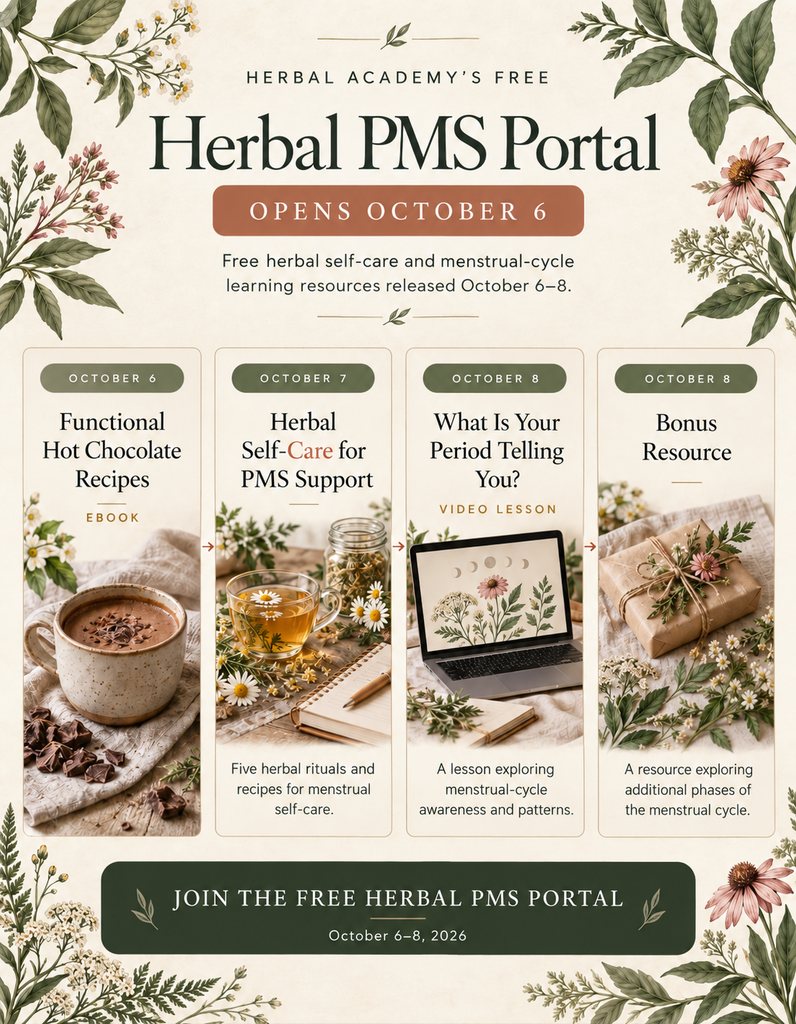
If you’ve been curious about herbal approaches to menstrual self-care but aren’t quite ready to dive into a full herbalism course, Herbal Academy is opening a new free Herbal PMS Portal on October 6, 2026.
New resources will be released through October 8, including a functional hot chocolate recipe ebook, herbal self-care ideas for the days before your period, and a lesson exploring what your menstrual cycle may be telling you.
What caught my attention isn’t only that these resources are free.
For someone beginning to study herbalism, they can also become a useful starting point for learning how to notice patterns, research unfamiliar herbs, and ask better questions about menstrual self-care.
Below, I’ll walk through what’s included, when each resource becomes available, and how you can use the portal as more than a collection of recipes.
Affiliate disclosure: This post may contain affiliate links. If you make a purchase through one of these links, The Calm Herbalist may earn a commission at no additional cost to you.
Herbal Academy PMS Portal 2026: At a Glance
| What | Free Herbal PMS Portal from Herbal Academy |
| Opens | October 6, 2026 |
| New resources | October 6–8 |
| Cost | Free |
| Includes | Functional hot chocolate recipes, herbal PMS self-care resources, menstrual-cycle education, and a bonus |
| Best for | Beginners interested in herbalism, menstrual-cycle awareness, and gentle self-care |
Explore the Free Herbal PMS Portal
What Is the Herbal Academy PMS Portal?
The Herbal PMS Portal is a free educational collection from Herbal Academy focused on premenstrual self-care and menstrual-cycle awareness.
Rather than being a complete herbalism course, it is a short series of resources being released over several days.
According to Herbal Academy’s announcement, the portal includes three primary gifts plus a bonus:
- a functional hot chocolate recipe ebook;
- five herbal self-care rituals and recipes;
- a menstrual-cycle video lesson;
- and an additional resource exploring other phases of the cycle.
If you are new to herbalism, that makes the portal a relatively easy way to explore the topic without trying to learn everything about reproductive herbalism at once.
And that is how I would approach it.
You don’t need to turn every recipe or herb you encounter into something you immediately try.
Instead, use the material to learn, notice, research, record, and reflect.
We’ll come back to that process below.
Herbal PMS Portal 2026: Key Dates
Here is the current release schedule provided by Herbal Academy:
| Date | Free Resource |
| October 6 | Functional Hot Chocolate Recipes Ebook |
| October 7 | Herbal Self-Care for PMS Support |
| October 8 | What Is Your Period Telling You? video lesson |
| October 8 | Bonus menstrual-cycle resource |
Let’s look at each one more closely.
October 6: Functional Hot Chocolate Recipes Ebook
The first resource is probably the most immediately inviting: a collection of functional hot chocolate recipes designed around different phases of the menstrual cycle.
Herbal Academy introduces the ebook through the familiar experience of wanting chocolate around the time of your period.
You could simply make the recipes and enjoy them.
But if you’re studying herbalism, I think there is a better way to use this resource.
Use the recipe as a mini herbal study exercise
As you read a recipe, notice any botanical ingredients you haven’t worked with before.
Then ask:
- What is the common name of this plant?
- What is its botanical name?
- Which part of the plant is being used?
- How has it traditionally been used?
- What does current research actually tell us?
- Are there important safety considerations?
- Does the preparation method make sense for this herb?
You don’t have to answer everything at once.
Choose one unfamiliar herb and follow that question for a while.
That is much more useful than collecting a long list of “good herbs for PMS” without understanding any of them very well.
If you’re new to this process, start with:
[How to Research an Herb for Your Materia Medica]
You can also begin building your own reference system with:
[How to Start a Materia Medica: A Beginner’s Step-by-Step Guide]
The goal isn’t to turn a cup of hot chocolate into homework.
It’s simply to become a little more curious about what you’re using.
October 7: Herbal Self-Care for PMS Support
The second gift focuses on five herbal rituals and recipes for the days leading up to menstruation.
Herbal Academy says these resources explore areas such as menstrual discomfort, sleep, and other experiences that can occur before a period.
This is where I would encourage a little extra discernment.
A comforting ritual and a treatment claim are not the same thing
An herbal bath, cup of tea, warm compress, evening routine, or other self-care practice may be comforting.
That doesn’t automatically mean it has been clinically shown to treat PMS or an underlying health condition.
When reading herbal wellness material, try separating three things:
1. The ritual
Is this something that helps create rest, warmth, comfort, or a moment of attention?
2. Traditional herbal use
How has a particular plant been used historically or within specific herbal traditions?
3. Scientific evidence
Has the herb or preparation actually been studied for the claim being made—and how strong is that evidence?
Those three can overlap, but they aren’t interchangeable.
The Office on Women’s Health notes that research results for several herbal supplements commonly used for PMS are mixed.
Learning to notice that distinction is one of the most useful skills you can build as a beginning herbal student.
October 8: What Is Your Period Telling You?
The third resource is a video lesson from Selima Harleston Lust, who is currently listed by Herbal Academy as one of its Lead Herbalist Educators.
The lesson moves beyond individual recipes and asks a broader question:
What can you learn by paying attention to your menstrual cycle?
This is a useful direction because menstrual self-care doesn’t have to begin with choosing an herb.
Sometimes it begins with noticing.
You might record:
- when symptoms begin;
- when they improve;
- menstrual dates;
- sleep;
- energy;
- mood changes;
- cravings or appetite changes;
- digestive changes;
- discomfort;
- herbal preparations you’ve tried;
- questions you want to research later.
You don’t need to interpret every change yourself.
You’re simply creating a clearer record.
The American College of Obstetricians and Gynecologists recommends recording symptoms daily for at least 2–3 months when trying to establish whether there is a recurring PMS pattern.
That is one reason I’m developing a future Calm Cycle + Herbal Self-Care Tracker for The Calm Herbalist.
The idea will be simple:
TRACK → NOTICE → REFLECT
Rather than trying to diagnose yourself, you’ll have a structured place to notice patterns and record questions worth exploring.
October 8 Bonus: Looking Beyond PMS
Herbal Academy’s announcement also mentions a surprise resource arriving on October 8 that expands the discussion beyond PMS into other parts of the menstrual cycle.
The email specifically mentions the:
- follicular phase;
- ovulatory phase;
- luteal phase.
I won’t speculate about the exact content before it is released.
But this is an important direction.
It is easy to think about the menstrual cycle only when your period arrives—or when something feels uncomfortable.
Understanding the broader cycle gives you much more context for what you’re observing.
I’ll be exploring this separately on The Calm Herbalist in:
The 4 Menstrual Cycle Phases: A Beginner’s Guide
How to Get More From the Free Herbal PMS Portal
Free resources are easy to collect.
Learning from them is harder.
You download the ebook.
Save the recipe.
Open five browser tabs.
Maybe pin something for later.
And a month later, you have more herbal information but don’t necessarily understand herbs any better.
Instead, try using the portal with this five-step process:
1. LEARN
Go through the resource once without trying to memorize everything.
Notice the main idea.
What is the lesson actually trying to teach?
2. NOTICE
Pay attention to what makes you curious.
Maybe it is:
- an herb you’ve never encountered;
- a preparation method;
- a claim you want to verify;
- a question about your own cycle;
- a safety consideration you hadn’t thought about.
Write it down.
3. RESEARCH
Choose one useful question.
Not ten.
For example:
“What do reputable sources say about this particular herb?”
Then research that question from more than one source.
If you aren’t sure how, see:
How to Research an Herb for Your Materia Medica
4. RECORD
Put useful information somewhere you can find it again.
That could be:
- a materia medica;
- an herbal monograph;
- your study notebook;
- a source tracker;
- a menstrual-cycle journal.
If you’ve heard the term herbal monograph but aren’t sure what one should contain, read:
What Is an Herbal Monograph? A Beginner’s Guide
5. REFLECT
Finally, ask:
What did I actually learn?
What remains uncertain?
What should I research next?
Is there anything I should discuss with a qualified healthcare professional?
You don’t need to become an expert in one afternoon.
Good herbal study is often quieter than that.
One useful question at a time is enough.
A Quick Note About Herbal PMS Advice
The word natural doesn’t automatically mean that something is safe for everyone.
Scientific evidence varies widely among herbal products, and products sold commercially may differ from the specific preparations used in research. Herbs and supplements can also interact with prescription or over-the-counter medicines.
Before trying an unfamiliar herb, consider checking:
- possible medication interactions;
- pregnancy or breastfeeding cautions;
- allergies;
- existing health conditions;
- the plant part being used;
- preparation method;
- appropriate amount and frequency;
- the reliability of the source making the recommendation.
If you take medication, NCCIH recommends telling your healthcare providers about the supplements and herbal products you use so they can help identify potential interactions.
That doesn’t mean you need to be afraid of herbs.
It means safety is part of herbal knowledge, not something added after the interesting part.
What If Your PMS Symptoms Are More Than Mild?
A free herbal resource can help you learn.
It cannot tell you why you’re experiencing a particular symptom.
PMS can involve physical and emotional symptoms, but other conditions can overlap with or resemble PMS. ACOG lists examples including anxiety, depression, thyroid disease, irritable bowel syndrome, perimenopause, and chronic fatigue syndrome.
If your symptoms significantly interfere with daily life, persist, worsen, or concern you, consider discussing them with an appropriate healthcare professional rather than assuming they are simply something you need to “push through.”
Your observations can still be useful.
They just become information you can bring into that conversation.
What If the PMS Portal Makes You Want to Study Herbalism More Deeply?
That may be one of the most useful outcomes of a free resource like this.
A recipe can introduce you to a plant.
But eventually you may want to understand:
- why herbalists select particular herbs;
- how preparations differ;
- how to research safety;
- how dosing is approached;
- how to build a materia medica;
- how herbalists study body systems rather than isolated symptoms.
For beginners who want that kind of structure, Herbal Academy’s Introductory Herbal Course currently includes herbal preparations, foundational materia medica, safety concepts, and a reproductive-health lesson that includes menstruation and health.
Explore Herbal Academy’s Introductory Herbal Course
You certainly don’t need to enroll in a course simply because you downloaded a free resource.
For many people, the portal itself may be enough.
But if it makes you realize that you’d rather learn herbalism systematically than piece everything together from recipes and social media, structured study can be a logical next step.
Is the Free Herbal PMS Portal Worth Joining?
For a beginner interested in both herbalism and menstrual-cycle awareness, I think it is worth exploring—particularly because the resources are free and cover several different ways of learning.
But I wouldn’t approach it as a collection of ready-made answers.
Approach it as a starting point.
Try this:
LEARN → NOTICE → RESEARCH → RECORD → REFLECT
Make the hot chocolate if it appeals to you.
Explore the self-care rituals.
Watch the lesson.
But also stop when an herb or idea catches your attention.
Look it up.
Check the source.
Record what you learn.
Ask another question.
That process is ultimately more valuable than collecting one more list of herbs.
Explore the Free Herbal PMS Portal
Frequently Asked Questions
What is the Herbal Academy PMS Portal?
The Herbal PMS Portal is a free Herbal Academy educational event focused on PMS, menstrual-cycle awareness, herbal self-care, recipes, and related learning resources.
When does the Herbal PMS Portal open?
The first resource is scheduled to open on October 6, 2026, with additional resources released October 7 and October 8.
Is the Herbal Academy PMS Portal free?
Yes. Herbal Academy is promoting the portal and the announced resources as free.
What is included?
The announced resources are:
- Functional Hot Chocolate Recipes ebook;
- Herbal Self-Care for PMS Support;
- What Is Your Period Telling You? video lesson;
- an additional menstrual-cycle bonus resource.
Is this a full Herbal Academy course?
No. The Herbal PMS Portal is a free collection of educational resources rather than one of Herbal Academy’s complete herbalism training programs.
Can beginners use the portal?
Yes. Based on the material Herbal Academy has announced, the portal is accessible to people beginning to explore menstrual-cycle awareness and herbal self-care.
If you encounter an unfamiliar herb, however, take time to research its safety and appropriate use rather than assuming every botanical preparation is suitable for everyone.
A Calm Way to Continue
If you join the portal, don’t worry about learning everything it contains.
Choose one useful idea.
Study one herb.
Record one pattern.
Follow one question.
Then return when you’re ready.
That’s usually a much calmer—and more sustainable—way to learn herbalism.