If you’re beginning to learn about herbs and menstrual health, you’ve probably encountered colorful charts assigning different herbs, teas, foods, or rituals to each phase of the menstrual cycle.
Menstruation gets one set of herbs.
The follicular phase gets another.
Ovulation has its own recommendations.
Then everything changes again during the luteal phase.
It can make menstrual herbalism look beautifully organized.
It can also make it more confusing than it needs to be.
A better place to begin is not:
“Which herb should I take during each phase?”
Start with:
“What is actually happening during each phase—and what herbal questions make sense from there?”
That’s what we’ll do in this guide.
We’ll walk through the four commonly described phases of the menstrual cycle, look at the basic physiology behind each one, and explore how a beginning herbal student can use that knowledge without turning the cycle into a rigid four-part herbal protocol.
The Four Menstrual Cycle Phases at a Glance
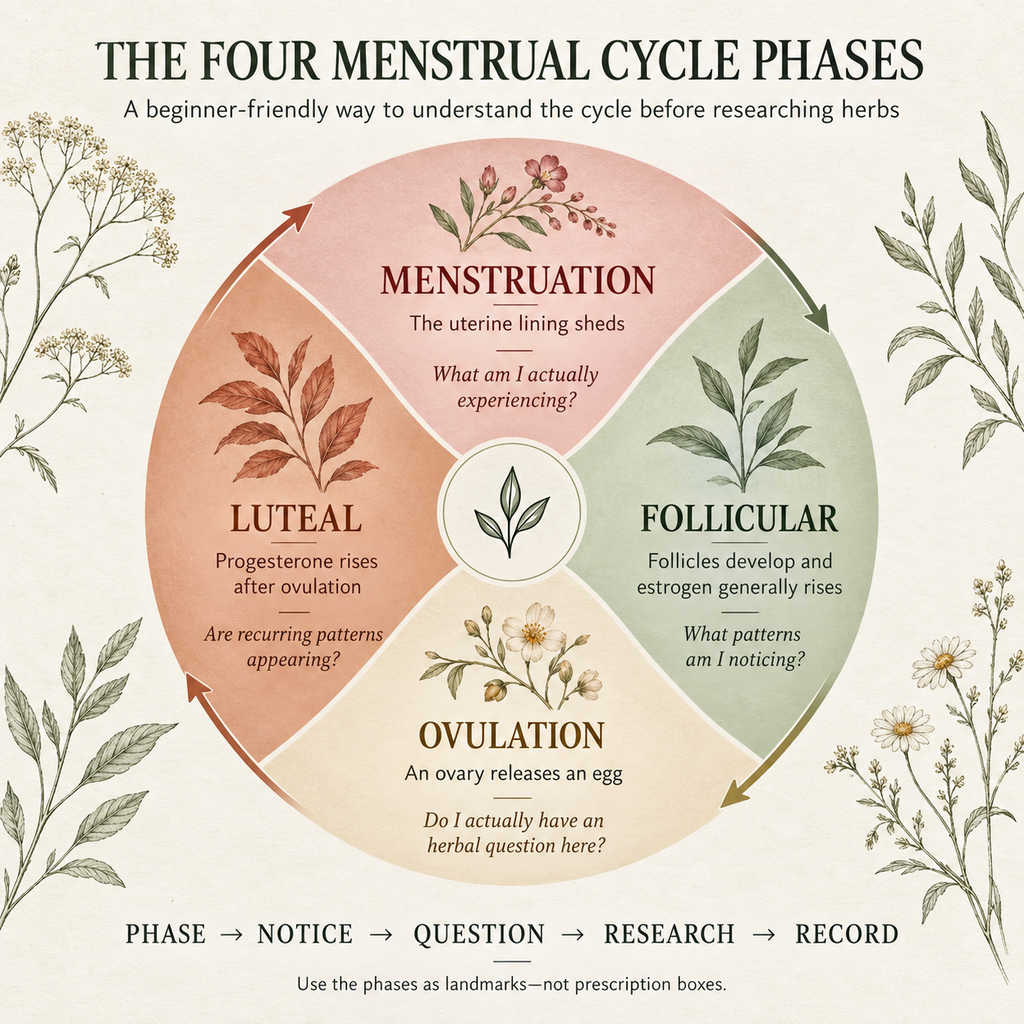
A commonly used four-phase learning model looks like this:
| Phase | What’s happening | Herbal learning question |
| Menstruation | The uterine lining is shedding | Are there symptoms or comfort needs worth investigating? |
| Follicular phase | Ovarian follicles develop and estrogen generally rises | What patterns do I notice as the cycle progresses? |
| Ovulation | An ovary releases an egg | Can I recognize ovulation without assuming I need to “support” it with herbs? |
| Luteal phase | Progesterone rises after ovulation and later falls if pregnancy doesn’t occur | Do recurring premenstrual symptoms appear here? |
There is one useful technical detail to understand before we go further.
The four phases are a learning model
From an ovarian physiology perspective, the menstrual cycle is commonly divided into two primary phases:
follicular → ovulation → luteal
The follicular phase actually begins on Day 1 of menstrual bleeding, which means menstruation overlaps with the early follicular phase rather than existing as a completely separate ovarian phase.
Still, treating menstruation separately can be useful when learning because bleeding is such a visible and meaningful part of the cycle.
So throughout this article, we’ll use:
MENSTRUATION → FOLLICULAR → OVULATION → LUTEAL
as a beginner-friendly framework while remembering that biology isn’t divided into four perfectly separate boxes.
First: Don’t Assume Every Cycle Is 28 Days
The familiar diagrams showing:
Day 1 → Day 14 ovulation → Day 28
are examples, not universal schedules.
The U.S. Office on Women’s Health notes that adult menstrual cycles commonly range from about 24 to 38 days, and cycle length can vary from month to month.
Ovulation also doesn’t automatically occur on Day 14.
The timing before ovulation can vary substantially between individuals and from one cycle to another.
That means one of the most useful habits you can develop isn’t memorizing a calendar.
It’s learning to observe your own patterns.
Keep that idea in mind as we move through the phases.
Phase 1: Menstruation
What is happening?
Day 1 of menstrual bleeding marks the beginning of a new menstrual cycle.
If pregnancy hasn’t occurred, estrogen and progesterone levels fall. That hormonal change contributes to the shedding of the uterine lining, which leaves the body as menstrual blood and tissue.
Bleeding often lasts several days, although experiences differ.
You may also experience symptoms such as:
- cramping;
- fatigue;
- headaches;
- digestive changes;
- back discomfort;
- changes in mood.
Not everyone experiences these symptoms, and severity varies considerably.
How should a beginner think about herbs during menstruation?
This is where I would avoid asking:
“What is the menstrual-phase herb?”
There isn’t one.
Instead ask:
What am I actually trying to understand?
Perhaps you’re curious about:
menstrual cramps
or:
a warming tea ritual
or:
an herb you’ve seen repeatedly mentioned for menstrual discomfort.
That gives you something specific to research.
Ginger is a useful example
Ginger (Zingiber officinale) is often discussed in relation to menstrual discomfort.
NCCIH reports that research suggests ginger dietary supplements may help reduce the severity of menstrual cramps.
Notice the wording.
It does not mean:
“Everyone should drink ginger tea during menstruation.”
And research involving a particular ginger supplement doesn’t automatically prove that every ginger tea, tincture, powder, or recipe produces the same effect.
That’s an important herbal-study lesson.
When you encounter a claim, ask:
- What preparation was studied?
- What amount was used?
- Who participated?
- What outcome was measured?
- Does the research apply to the preparation I’m considering?
This is much more useful than putting “ginger” inside a menstrual-phase box.
Phase 2: The Follicular Phase
What is happening?
The follicular phase begins on the first day of menstruation and continues until ovulation.
During this phase, follicle-stimulating hormone, or FSH, helps stimulate follicles in the ovaries to develop.
One follicle typically becomes dominant.
As it develops, estrogen generally rises. The uterine lining also begins rebuilding in preparation for the possibility of pregnancy.
Because menstruation occurs during the early part of the follicular phase, you may see different diagrams that appear to disagree.
One might show:
Menstrual → Follicular
while another says:
Follicular begins on Day 1.
Both may simply be using different ways of organizing the cycle.
What does this mean for herbal study?
Online cycle-syncing charts sometimes recommend particular herbs during the follicular phase to:
- “boost estrogen”;
- “detox estrogen”;
- “balance hormones”;
- “prepare for ovulation.”
Those phrases deserve careful examination.
Normal reproductive hormones are supposed to change throughout an ovulatory menstrual cycle.
The fact that estrogen rises doesn’t automatically mean it needs to be increased, decreased, detoxified, or “balanced.”
So instead of immediately looking for a follicular-phase herbal formula, use this phase to practice observation.
Ask:
- How long is this part of my cycle?
- What changes do I notice after menstruation ends?
- Do my energy, sleep, appetite, mood, or cervical fluid change?
- Are those changes consistent from cycle to cycle?
- Is there actually a problem I’m trying to address?
Sometimes the answer may simply be:
Nothing needs fixing.
That is useful information too.
Phase 3: Ovulation
What is happening?
Ovulation is the release of an egg from an ovary.
As a dominant follicle develops, rising estrogen helps trigger a surge in luteinizing hormone, or LH. That hormonal surge leads to the release of the mature egg.
The exact timing varies.
Signs associated with ovulation can include changes in cervical mucus and a slight shift in basal body temperature.
Ovulation is therefore better understood as a physiological event than as a week-long lifestyle category.
Do you need special “ovulation herbs”?
Not necessarily.
This is another place where social-media charts can make normal physiology sound like something that requires constant intervention.
If you have no specific concern, there is no obvious reason you must take an herb simply because ovulation is occurring.
For a beginner herbal student, this phase can instead teach an important principle:
Start with the question, not the herb.
For example:
“I’m learning how ovulation works.”
is different from:
“I’m trying to investigate irregular ovulation.”
And both are very different from:
“Which tea should everyone drink during ovulation?”
The more specific the question becomes, the easier it is to determine whether an herb is even relevant.
Phase 4: The Luteal Phase
What is happening?
After ovulation, the follicle that released the egg becomes a temporary structure called the corpus luteum.
The corpus luteum produces progesterone along with some estrogen.
Progesterone helps prepare the uterine lining for possible implantation.
If pregnancy doesn’t occur, the corpus luteum breaks down. Estrogen and progesterone levels decline, eventually leading to menstruation and the beginning of the next cycle.
This is also the phase when some people begin noticing premenstrual symptoms.
These may include things such as:
- bloating;
- breast tenderness;
- appetite changes;
- mood changes;
- headaches;
- fatigue;
- sleep changes.
Patterns differ substantially among individuals.
The Luteal Phase Is Where Symptom Tracking Becomes Especially Useful
If symptoms repeatedly appear during the days before menstruation, don’t immediately jump to:
“Which herb balances progesterone?”
First document the pattern.
Ask:
- When does the symptom begin?
- How severe is it?
- Does it occur every cycle?
- Does it improve once menstruation begins?
- What else changes at the same time?
- Does it interfere with work, sleep, relationships, or daily life?
For PMS evaluation, ACOG recommends prospective symptom recording over multiple cycles rather than relying only on memory.
That is one reason cycle tracking can be more useful than collecting another list of PMS herbs.
What About Vitex?
Chasteberry, also called vitex (Vitex agnus-castus), is one of the herbs you’re likely to encounter when researching PMS.
It makes a useful example of why herbal research needs nuance.
NCCIH reports that some studies suggest chasteberry may help reduce certain PMS symptoms, including breast pain or tenderness, but says higher-quality evidence is still needed before firm conclusions can be drawn.
There are also important safety considerations.
NCCIH notes concerns around pregnancy, breastfeeding, and hormone-sensitive conditions.
So:
Vitex has been studied for PMS
is a reasonable statement.
But:
Vitex is the herb everyone should take during the luteal phase
is a much bigger claim.
Those aren’t the same thing.
That distinction is exactly what beginning herbal students need to learn.
Do You Need Different Herbs for Every Phase?
This is where I would be especially cautious.
You can easily find online charts assigning herbs to:
menstruation → follicular → ovulation → luteal
But individual herbs being traditionally used or studied for particular symptoms is not the same thing as having clinical evidence that everyone benefits from rotating four herbal protocols across the month.
Research into menstrual-cycle effects in other areas such as exercise also shows substantial person-to-person variation, and systematic reviews have cautioned against universal phase-based prescriptions in favor of more individualized approaches.
So I would use the four phases primarily as a learning framework, not as four prescription boxes.
A Better Way to Study Herbs Across Your Cycle
Instead of:
PHASE → TAKE THIS HERB
try:
PHASE → NOTICE → QUESTION → RESEARCH → RECORD

Here’s what that can look like.
1. PHASE
Learn roughly where you are in your cycle.
Don’t worry about making the calendar perfect.
2. NOTICE
Pay attention to what you’re actually experiencing.
Maybe there’s nothing unusual.
Maybe there’s a repeating symptom.
3. QUESTION
Turn your observation into one useful question.
For example:
Why do I experience cramps during the first day of menstruation?
or:
What evidence exists for ginger and menstrual discomfort?
4. RESEARCH
Check more than one reliable source.
Look for:
- botanical name;
- plant part;
- traditional use;
- preparation;
- modern research;
- safety;
- interactions;
- uncertainties.
5. RECORD
Add useful findings to your:
- materia medica;
- herbal monograph;
- source tracker;
- cycle journal.
Now you’re actually building herbal knowledge.
Try Building a Cycle-Aware Materia Medica
You don’t need a separate materia medica for every phase.
Instead, when researching an herb connected to menstrual health, consider adding fields such as:
Herb:
Botanical name:
Plant part:
Preparation:
Traditional use:
Menstrual-health question:
Cycle phase where the question arose:
Evidence found:
Safety considerations:
Medication interactions:
Sources:
What remains uncertain?
For example:
Ginger
Question: Has ginger been studied for menstrual cramping?
Instead of:
Phase: Menstrual
Therefore: Take ginger.
That small shift keeps your materia medica educational rather than prescriptive.
If you’re just beginning, see:
How to Start a Materia Medica: A Beginner’s Step-by-Step Guide
and:
[How to Research an Herb for Your Materia Medica]
What About “Cycle Syncing”?
The phrase cycle syncing usually describes changing food, exercise, work, supplements, or self-care practices according to menstrual-cycle phases.
The underlying idea of paying attention to your cycle can be useful.
But detailed universal prescriptions deserve more caution.
Even research on exercise across menstrual phases has found inconsistent effects and substantial individual variability. One systematic review concluded that broad phase-based exercise guidelines couldn’t be justified from the evidence and recommended an individualized approach instead.
So there’s a useful distinction:
Cycle awareness
“I notice recurring patterns and respond to what my body is actually experiencing.”
versus:
Rigid cycle syncing
“It’s Day 9, so I must eat, exercise, work, and use herbs according to this chart.”
The first encourages observation.
The second can create rules that may not reflect your actual cycle.
For The Calm Herbalist, we’ll focus on the first.
Herbal Safety Still Matters in Every Phase
An herb doesn’t become safe simply because a chart places it in the “correct” phase.
Whenever you’re researching a new botanical, consider:
- pregnancy or breastfeeding;
- medications;
- hormonal medications;
- health conditions;
- allergies;
- dosage;
- plant part;
- preparation;
- duration of use;
- quality of evidence.
For example, NCCIH advises people taking medicines to discuss herbal products with healthcare professionals because some herbs and medicines can interact in harmful ways.
Safety isn’t a separate chapter from herbalism.
It’s part of learning the herb.
When Cycle Tracking Deserves Medical Follow-Up
Learning your cycle can help you recognize patterns, but a blog or herbal chart can’t diagnose why something is happening.
Consider speaking with an appropriate healthcare professional if you experience concerns such as:
- very heavy bleeding;
- severe or worsening pain;
- menstrual symptoms that significantly disrupt daily life;
- cycles that change substantially without an obvious explanation;
- possible pregnancy;
- symptoms that worry you.
Cycle awareness should help you ask better questions—not pressure you to explain every symptom yourself.
How Herbal Academy Approaches Menstrual-Cycle Study
If you’re interested in studying reproductive herbalism more systematically, Herbal Academy currently includes “The Moon Cycle: Menstruation and Health” within the reproductive-health section of its Introductory Herbal Course.
Its Advanced Herbal Course goes considerably deeper, including reproductive physiology, the menstrual cycle, PMS, dysmenorrhea, amenorrhea, and menorrhagia.
Explore Herbal Academy’s Introductory Herbal Course
Affiliate disclosure: If this article contains affiliate links and you make a qualifying purchase through one of them, The Calm Herbalist may earn a commission at no additional cost to you.
Structured education isn’t necessary simply to become more aware of your cycle.
But it can be helpful if your interest moves from:
“Which tea should I drink?”
to:
“How do herbalists actually study reproductive health, safety, preparations, and evidence?”
Four Phases, One Better Learning Habit
The four-phase model can make the menstrual cycle easier to understand.
Just don’t let it convince you that every phase requires another supplement, tea, tincture, or intervention.
Use the phases as landmarks.
Notice what happens.
Track patterns.
Choose one question.
Research one herb carefully.
Record what you learn.
Then return to the cycle with a little more understanding than you had before.
A simple approach is enough:
LEARN → NOTICE → RESEARCH → RECORD → REFLECT
You don’t need four herbal protocols.
You need a better way to learn.