If you’re trying to learn herbalism and currently have a stack of books, several saved Instagram posts, a Pinterest board full of herbs, and fourteen browser tabs open, you probably don’t need another list of 50 things to study.
You need a starting point.
Herbalism can lead you toward plants, botany, preparation methods, traditional practices, gardening, materia medica, anatomy, research, safety, and much more. Trying to understand all of it before you begin is a reliable way to spend more time collecting information than actually learning.
A simpler approach is to build your herbal knowledge in small, repeatable study sessions.
Start with a very small number of plants. Keep your notes somewhere you can find them again. Learn how to check important information rather than relying on a single post or book. Study one subject at a time. Then record what you learned and what needs more investigation.
That is enough to begin.
First, decide what you’re trying to learn
“Learn herbalism” can mean several different things.
One person may want to recognize and understand herbs growing in a home garden. Another wants to learn more about dried herbs already sitting in the pantry. Someone else may be interested in tea making, keeping a home apothecary, building a materia medica, or eventually taking a structured herbal course.
You don’t need to decide what herbalism will mean to you forever. You only need a useful direction for your next stretch of study.
Try finishing this sentence:
Right now, I want to learn enough herbalism to ________.
Your answer might be:
- study individual herbs more carefully
- understand the ingredients in herbal teas
- start a personal materia medica
- organize a small home apothecary
- grow and document a few herbs
- understand basic herbal preparation terminology
- decide whether a formal course would help you
That answer gives your study somewhere to go.
Without it, it’s easy to jump from tinctures to gardening to herbal actions to plant identification in a single evening and finish with twelve pages bookmarked but very little you could explain tomorrow.
Start with fewer herbs than you think you need
A beginner doesn’t need a cabinet filled with dozens of dried plants.
Buying herbs faster than you can study or use them can create another problem: jars you barely remember purchasing, labels you haven’t recorded properly, and notes that don’t quite match what is on the shelf.
Start with a very small group that feels manageable.
They might already be growing in your garden, sitting in your spice cupboard, appearing in teas you already buy, or discussed in the beginner resource you’re using.
The goal at this stage isn’t to become familiar with as many plants as possible.
It is to learn what studying one plant carefully actually involves.
For one plant, you might gradually investigate:
- its common name
- its scientific or botanical name
- the plant family
- which plant part your reference is discussing
- how different references describe it
- preparation types associated with it
- safety information
- questions you still need to investigate
- where each piece of information came from
You don’t have to fill every field during your first session.
Your notes are allowed to grow as your understanding grows.
Build your materia medica from the beginning
You’ll encounter the term materia medica frequently in herbal education.
For a home learner, a practical way to think about it is as an organized collection of your individual herb studies.
Each entry gives you somewhere to bring together what you’re learning about one plant instead of leaving the information scattered between books, screenshots, bookmarks, loose notes, and browser tabs.
Your entry does not need to look like an encyclopedia article.
A useful beginner page might contain the herb’s common name, scientific name, plant family, plant part discussed, preparation information you encounter, safety notes, references, your own observations, and questions that still need research.
One field deserves a permanent place:
Source.
If you write down that a plant has a particular use, action, preparation method, safety concern, or traditional application, record where you found the information.
Otherwise, six months later you may have a beautifully organized page and no idea whether one sentence came from a botanical reference, an herbal textbook, a university resource, a product description, or a social-media caption.
Herbal Academy makes this principle unusually explicit in its preparation guidance for students. It recommends using several herbal books and cross-referencing materia medica research against at least three sources because herbal information can vary.[1] (Herbal Academy)
That is Herbal Academy’s study recommendation, not a rule that every beginner must attach exactly three citations to every sentence.
The useful principle is simpler:
Important herbal information should be traceable.
What Is a Materia Medica? A Beginner-Friendly Guide
How to Create Your Own Materia Medica as a Beginner
Give each study session one job
If your notes are split between a notebook, saved posts, and three browser tabs, finding the information again becomes part of the work.
A repeatable study rhythm can reduce that problem.
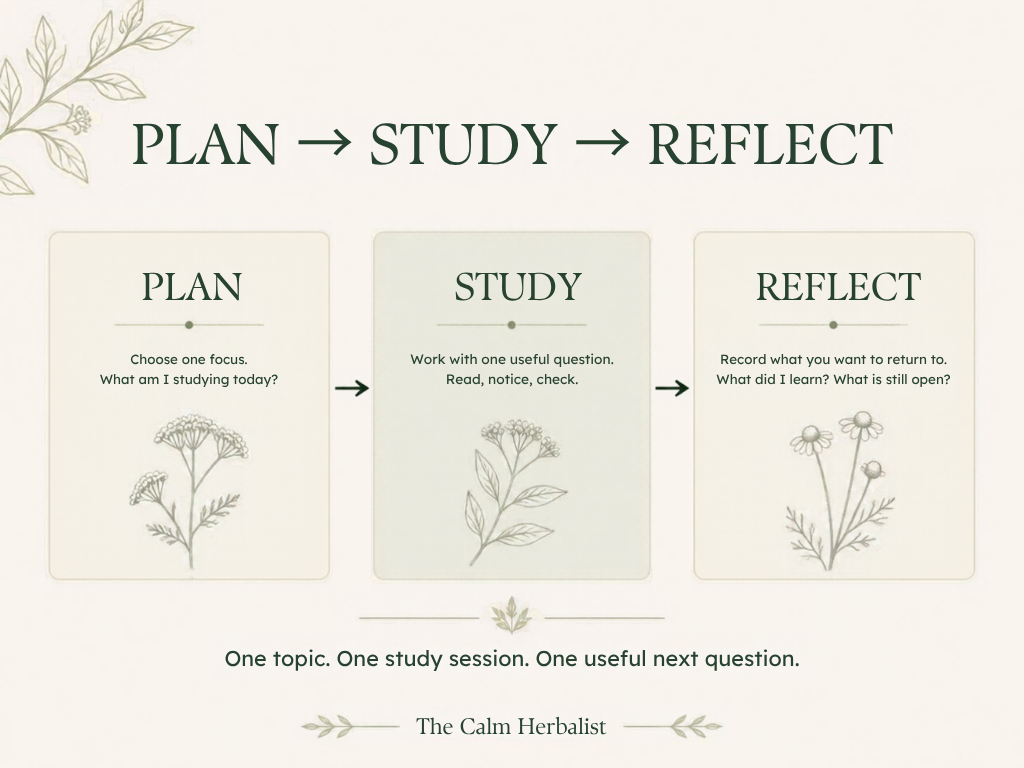
The Calm Herbalist uses:
PLAN → STUDY → REFLECT
PLAN
Decide what you’re working on before opening several resources.
For example:
Plant: one herb you’ve chosen to study
Topic: names and identity
Sources: a trusted reference plus an authoritative botanical database
Study question: What plant am I actually studying, and what names are used for it?
The point is not to make every study session rigid.
It is to stop one question from quietly turning into fifteen unrelated ones.
STUDY
Work on the question you chose.
Read carefully. Take notes in your own words. Record the source beside information you’ll want to verify or find again.
If something seems important, surprising, highly specific, safety-related, or different from what another source says, mark it for further checking.
You do not have to resolve every question immediately.
Need to research this later is a useful study note.
REFLECT
At the end, ask what you actually learned.
What remains unclear?
Did your sources agree?
Did you encounter a term you don’t understand yet?
What is the most logical subject for the next session?
Reflection prevents your notebook from becoming simple storage. It gives you a record of what is settled, what is uncertain, and what needs another look.
Not sure what to study today?
The Free Herbal Study Session Planner is designed around this one narrow problem. Use it to plan a study question, keep track of what you worked on, and decide what deserves attention next.
FREE HERBAL STUDY SESSION PLANNER
Learn what a source can actually tell you
You don’t need to distrust everything online.
You do need to stop treating every source as though it performs the same job.
A social post might introduce you to a plant or term you haven’t seen before.
A beginner article may explain an unfamiliar idea in plain language.
A botanical institution may be the better place to check plant identity and accepted names.
A government health agency may be more appropriate when you’re checking supplement safety or documented interaction concerns.
A course provider is the primary source for the current structure, access terms, or curriculum of its own course.
A well-referenced herbal textbook may give you context that a two-paragraph web page cannot.
Before copying a claim into your notes, ask:
What kind of claim is this, and is this source appropriate for that claim?
Also notice whether an author shows where factual information came from. Be especially careful with confident health claims that have no references attached.
And don’t mistake repetition for verification.
If ten websites repeat the same sentence, that does not automatically mean ten independent sources confirmed it.
Your notes become more useful once you can distinguish between:
This source says…
and:
I checked this against appropriate references.
That difference is part of learning how to research herbs.
Learn the scientific name along with the common name
Scientific names can look like unnecessary homework when you’re beginning.
They solve a practical problem.
Royal Botanic Gardens, Kew notes that medicinal plants are known by different names across communities, languages, traditions, and generations—and that the same name may sometimes be applied to several different species.[2] (Kew Gardens)
That means a common name alone may not always tell you exactly which plant a source is discussing.
You don’t need to become a taxonomist before creating your first herb page.
Simply make scientific name a normal field in your records.
You’ll also discover that plants may have scientific synonyms or that accepted names can change as botanical knowledge is updated. Kew’s Medicinal Plant Names Services (MPNS) exists partly to resolve this kind of ambiguity. Its database lets users search plant names and identify accepted scientific names, synonyms, and medicinal references associated with those plants.[2] (Kew Gardens)
That makes botanical naming more than a vocabulary exercise.
It is part of keeping clear records.
If you later move from studying purchased herbs into identifying wild plants, the stakes become higher. Treat identification as a separate skill. A photograph, image search, or plant-identification app may be useful for generating possibilities, but it should not be treated as definitive identification when a mistake could matter.
That subject deserves its own careful article rather than a paragraph buried inside this one.
Study one preparation before trying to learn them all
Beginner herbal resources can introduce infusions, decoctions, tinctures, infused oils, salves, syrups, vinegars, powders, compresses, and other preparations in quick succession.
You don’t need to make all of them.
Choose one preparation type to understand.
Learn what the term means. Notice which plant parts your reliable references discuss in connection with it. Read the relevant safety information. If you decide to make something, work from an appropriate, dependable instruction rather than combining fragments from unrelated posts.
Then document what you did.
What source or recipe did you follow?
What ingredient did you use?
When did you prepare it?
What did you notice about the process, aroma, taste, texture, or appearance?
What would you need to check before making it again?
The preparation itself can become part of your study record.
There is plenty more to learn about individual preparation methods. A broad beginner article doesn’t need to become a tincture manual, tea-making manual, salve guide, and formulation course at the same time.
Keep learning about an herb separate from deciding whether to take it
Herbal study becomes much more complicated when every plant immediately turns into:
What should I take this for?
You can learn a great deal about an herb without deciding that you—or somebody else—should use it medically.
That distinction is especially useful for beginners.
NCCIH notes that scientific evidence for dietary supplements varies widely and that supplements can interact with medications or pose additional risks for people with certain medical conditions or around surgery.[3] (NCCIH) NCCIH also cautions that some herbal supplements can increase or decrease the effects of medicines, while information about many possible interactions is still limited.[4] (NCCIH)
The FDA makes a related point: a product being described as “natural” does not automatically make it safe. The agency also notes that some supplements can affect how medications are absorbed, metabolized, or eliminated.[5] (U.S. Food and Drug Administration)
This doesn’t mean you need to become frightened of every plant.
It means safety deserves its own place in your research rather than being added after you have already decided what you want an herb to do.
A useful materia medica entry might include a field such as:
Safety / contraindications / interactions to investigate
Notice the wording.
You’re creating somewhere to record and check questions rather than pretending every safety question has already been resolved.
If you’re pregnant or breastfeeding, giving products to children, taking medications, preparing for surgery, or managing a medical condition, decisions about using herbs or supplements deserve appropriate professional guidance. Studying a plant and deciding whether a particular person should use it are different tasks.
Do you need an herbalism course?
Not necessarily.
You can begin learning herbs through reputable books, botanical resources, careful note-taking, libraries, local classes, gardens, and structured self-study.
A course solves a different problem.
It gives you a sequence.
Instead of continually deciding which subject should come next, a curriculum organizes much of that decision-making for you.
That can be useful if you discover that most of your study time is being spent collecting resources and planning rather than learning.
If you consider a paid course, look beyond the sales page headline.
Check:
- who the program says it is for
- what is actually included in the curriculum
- how safety is handled
- the type and duration of access
- whether there are quizzes, instructors, or community support
- what any certificate represents
- what the current price and refund terms are
- whether the teaching style suits how you learn
One structured option: Herbal Academy’s Introductory Herbal Course
Disclosure: This article contains affiliate links. If you purchase through one of these links, The Calm Herbalist may earn a commission at no additional cost to you.
Herbal Academy currently describes its Introductory Herbal Course as a self-paced online program for students with little or no herbal experience. The current course page lists 34 lessons across six units and covers subjects including herbal basics, preparations, materia medica, kitchen herbs, gardening and wildcrafting, body systems, safety information, body care, and a holistic approach to herbalism.[6] (Herbal Academy)
The course page currently states that enrollment includes lifetime access, with an important qualification in the site’s terms: “lifetime” means access for as long as that particular course continues to be offered by Herbal Academy.[6] (Herbal Academy)
Visit Introductory Herbal Course Here
I would not choose a beginner course simply because an affiliate recommends it. Read the current curriculum yourself and decide whether what you are paying for is something you actually need: structured education.
That is also different from what The Calm Herbalist’s tools do.
Herbal Academy provides herbal education.
The Calm Herbalist helps you organize your own studying, research, notes, experiments, inventory, and records.
Those are complementary jobs, not competing versions of the same product.
What your first few study sessions could actually look like
You don’t need to design a six-month curriculum before opening your notebook.
Plan the next question.
One session might be:
Identify the plant clearly.
Record the common name, scientific name, plant family if relevant to your current study, and the plant part discussed in your source.
A later session might be:
Compare two or more references.
Where do they agree? Where do they use different terminology? Is one claim safety-sensitive enough to check against an authoritative source?
Another could focus entirely on:
Vocabulary.
What terms did you encounter that you still cannot explain in your own words?
A later session might look at:
One preparation.
What does the term mean? Which part of the plant does your source discuss? What information would you need before attempting it?
Then return to your notes.
What now makes sense that did not make sense before?
Which questions remain open?
What would be the sensible next subject?
That is already an herbal study practice.
Beginner habits that create unnecessary confusion
Buying before studying is one.
A beautiful home apothecary can be appealing, but owning many herbs doesn’t mean you’ve learned them. If inventory grows faster than your knowledge and recordkeeping, the shelves themselves become another project.
Constantly changing resources causes another problem.
You read several pages from one book, watch part of a video, save seven posts, open another ebook, and start a different notebook. Nothing stays in front of you long enough to become familiar.
Then there is unsourced note-taking.
If you copy claims without recording where they came from, you’re slowly building a reference you may not be able to evaluate later.
Common-name-only notes can also create ambiguity because plant names are not always unique.[2]
And perhaps the easiest habit to fall into is allowing curiosity to expand every session until it has no boundaries.
One herb leads to herbal actions. Herbal actions lead to anatomy. Anatomy leads to another plant. That plant leads to tinctures. Suddenly you’re comparing extraction methods when you sat down to identify a leaf.
Keep a later list.
Interesting questions do not disappear because you didn’t answer them tonight.
What progress actually looks like
Progress in herbalism does not have to mean memorizing enormous lists.
After a period of organized study, useful progress can look much quieter.
You can open your notes and find the information you recorded.
You know which plant a page refers to.
You can trace an important claim back to its source.
You notice when a claim needs stronger evidence.
You know the difference between something you’ve read once and something you’ve checked more carefully.
You can explain what you still don’t know.
You notice when two references disagree instead of automatically choosing whichever answer you saw first.
You have a small number of plants you’ve studied with attention rather than a large number of names you’ve briefly encountered.
And when you sit down to study, you know what you’re working on.
Once you can repeat that process, adding another herb, preparation, book, or course becomes much easier to manage.
Start with today’s study session
You do not need the perfect herbal library, a full apothecary, ten notebooks, or a complicated curriculum before you begin.
Choose one plant.
Choose one question.
Choose appropriate sources.
Take notes you can find again.
Record what still needs checking.
Then decide what comes next.
If the part you’re struggling with is simply what to study today, start with the Free Herbal Study Session Planner.
FREE HERBAL STUDY SESSION PLANNER
If individual sessions are going well but you want a way to organize your study practice over time, the 30-Day Herbalism Study Planner extends the same PLAN → STUDY → REFLECT approach across 30 study opportunities.
They do not have to be consecutive days. It isn’t a streak or productivity challenge. The planner is there to help you return to your herbal studies with a clear next step.
[LINK: 30-DAY HERBALISM STUDY PLANNER]
Start smaller than you think.
Add complexity when your questions actually require it.
B. Final References & Sources
These are the six clean direct source pages used in the article. I verified that each currently resolves to the specific public resource rather than an organization homepage. (Herbal Academy)
REFERENCES & SOURCES
1. Organization: Herbal Academy
Resource: Prepare For Class: Introductory Herbal Course
URL: https://theherbalacademy.com/prepare-for-class-introductory-herbal-course/
Supports: Herbal Academy’s recommendation that students begin a personal materia medica, use multiple herbal books, and cross-reference materia medica research against several sources.
2. Organization: Royal Botanic Gardens, Kew
Resource: Medicinal Plant Names Services
URL: https://www.kew.org/science/our-science/science-services/medicinal-plant-names-services
Supports: Statements concerning common-name ambiguity, accepted scientific names, synonyms, medicinal plant nomenclature, and use of Medicinal Plant Names Services to verify or disambiguate plant names.
3. Organization: National Center for Complementary and Integrative Health (NCCIH), National Institutes of Health
Resource: Dietary and Herbal Supplements
URL: https://www.nccih.nih.gov/health/dietary-and-herbal-supplements
Supports: Statements that scientific evidence concerning dietary supplements varies widely and that supplements may interact with medications or present additional risks in certain medical circumstances or around surgery.
4. Organization: National Center for Complementary and Integrative Health (NCCIH), National Institutes of Health
Resource: 6 Tips: How Herbs Can Interact With Medicines
URL: https://www.nccih.nih.gov/health/tips/tips-how-herbs-can-interact-with-medicines
Supports: Statements concerning potential herb–medicine interactions, including the possibility that herbal supplements may increase or decrease medication effects and that information about many possible interactions remains limited.
5. Organization: U.S. Food and Drug Administration (FDA)
Resource: Mixing Medications and Dietary Supplements Can Endanger Your Health
URL: https://www.fda.gov/consumers/consumer-updates/mixing-medications-and-dietary-supplements-can-endanger-your-health
Supports: Statements that “natural” does not necessarily mean safe and that certain dietary supplements can affect the absorption, metabolism, or excretion of medications.
6. Organization: Herbal Academy
Resource: Introductory Herbal Course
URL: https://theherbalacademy.com/product/introductory-herbal-course/
Supports: Current information concerning the Introductory Herbal Course, including its intended beginner audience, self-paced format, 34 lessons across six units, curriculum topics, and lifetime-access terms.